
More people are asking AI tools for recommendations instead of typing a search into Google. “What’s the best SEO agency in KL?” or “Recommend a good dentist near me” now gets answered directly inside ChatGPT, Gemini, Perplexity, or Google’s AI Overview — often without the user ever clicking through to a website. This shift means a new kind of visibility matters: not just ranking on Google, but being mentioned by AI when someone asks a relevant question. Here’s what that means and what you can actually do about it.
What is “AI visibility”?
AI visibility (sometimes called GEO — Generative Engine Optimization, or AEO — Answer Engine Optimization) is how often, and how favorably, your business gets mentioned when someone asks an AI tool a question related to what you do. It’s a different game from traditional SEO in one important way: instead of competing for a spot on a results page, you’re competing to be the fact an AI system chooses to reference in its answer.
Why this matters now
A large and growing share of searches are being answered directly inside AI tools, with no click to any website at all. If your business isn’t part of how those answers get formed, you become invisible for exactly the moments when someone is actively looking for what you offer.
5 things that actually affect your AI visibility

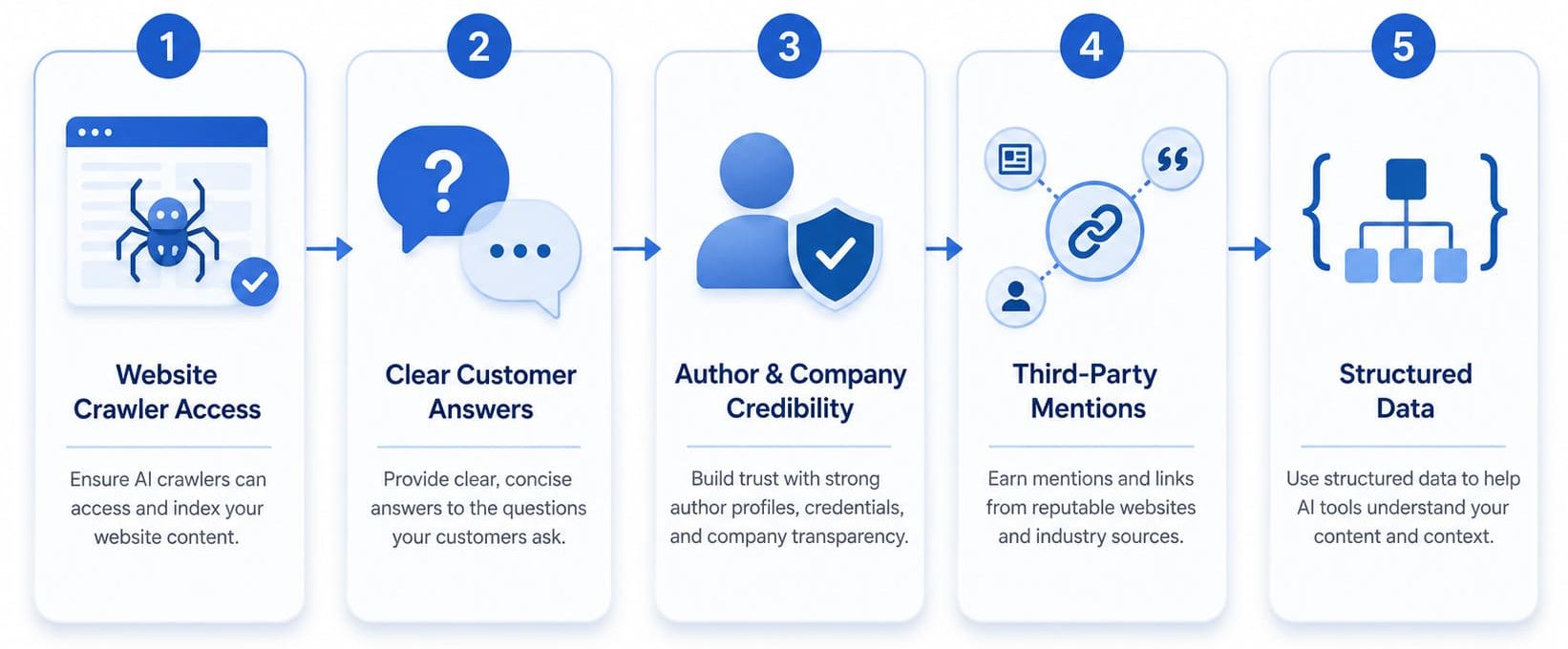
1. Make sure AI tools can actually read your site
This is the most overlooked step. Every major AI company runs “bots” that visit websites to gather information — similar to how Google’s search bot works. If your website’s settings (or your security/firewall tools) accidentally block these bots, you become invisible to that AI tool no matter how good your content is. What to do: Ask your web developer or agency to check your site’s robots.txt file and any firewall/security settings (like Cloudflare) to confirm AI bots such as ChatGPT’s and Perplexity’s crawlers are allowed in, not blocked by mistake.
2. Answer real questions clearly and directly
AI tools tend to pull short, clear, factual answers — not long marketing paragraphs. Pages that directly answer specific questions (in an FAQ format, for example) are much more likely to get picked up and quoted. What to do: Add a clear FAQ section to your key web pages. Write each question as a real thing a customer would ask, followed immediately by a short, direct 2–3 sentence answer.
3. Build credibility signals AI can recognize
AI tools weigh who is saying something, not just what’s said. A business with a named, credentialed team, a consistent online presence, and a clear track record is more likely to be trusted and cited than an anonymous-looking website. What to do: Add real author names and short bios to your articles and case studies. Keep your business name, address, and phone number written exactly the same way everywhere online — your website, Google Business Profile, and any directory listing.
4. Earn mentions elsewhere on the web
AI tools don’t just look at your own website — they weigh what independent sources say about you: reviews, news mentions, directory listings, and other websites referencing your business. This is similar to how word-of-mouth reputation works, just read by a machine instead of a person. What to do: Keep your Google Business Profile active and complete, encourage genuine customer reviews, and look for opportunities to be mentioned on reputable third-party sites relevant to your industry.
5. Use structured data so AI can “read” your facts cleanly
Behind the scenes, there’s a way to label your web content (called schema markup) so that facts like your business hours, services, pricing, or FAQs are clearly tagged for machines to understand — rather than AI having to guess by reading loose paragraphs. What to do: Ask your web team to add FAQ, Organization, and Service schema markup to your key pages. This is usually a manageable technical task, not a full website rebuild.
What AI visibility doesn’t replace
None of this replaces good, honest business practices — real reviews, real expertise, a real reputation. If anything, AI tools reward businesses that already have those things and simply weren’t presenting them in a machine-readable way. Think of AI visibility work as translation: taking the trust you’ve already earned and making it legible to a new kind of “reader.”
How to know if it’s working
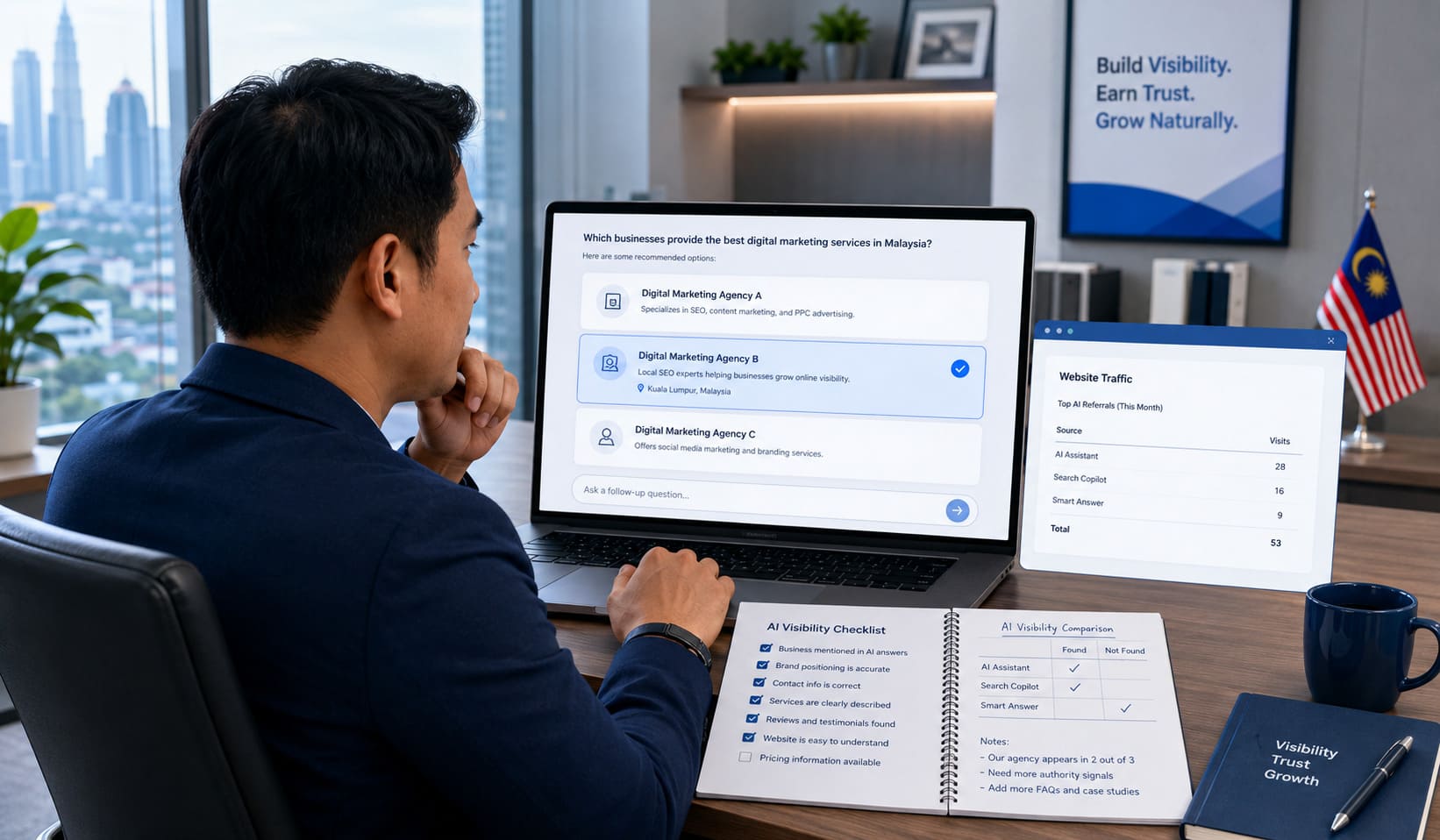
Two useful (and free-to-start) ways to check:
- Ask the AI tools yourself. Type in the real questions your customers would ask and see whether, and how, your business comes up.
- Check your website analytics. Tools like Google Analytics can show you traffic arriving specifically from AI tools like ChatGPT, and Google Search Console can show clicks coming from Google’s AI Overview — giving you a before-and-after view as you make improvements.
AI visibility is still a new and fast-changing area — what works today may need adjusting in six months. Businesses that start paying attention now, even with simple manual checks, will have a real head start over those who wait.
Want to know where your business stands right now?
Checking your AI visibility on your own is a great start — but knowing exactly what to fix, and doing it properly across your website’s technical setup, content, and credibility signals, is where most businesses get stuck. At Nuweb, we help businesses in Malaysia get found — not just on Google, but increasingly inside ChatGPT, Gemini, Perplexity, and Google AI Overview too. Contact Nuweb today!
